
1-MCP 3.3% – Complete Application Guide by Crop | Postharvest Preservation
1-MCP 3.3% — Complete Crop-Specific Application Guide
1-Methylcyclopropene (1-MCP) is globally recognized as one of the most effective ethylene action inhibitors available today, widely used for the postharvest preservation of fruits, vegetables, and ornamental crops. Its mechanism involves high-affinity binding to ethylene receptors (such as ETR1 and ERS1) in plant tissues, with an affinity approximately 10 times greater than that of ethylene itself. This nearly irreversible binding effectively blocks the ethylene signaling pathway, thereby delaying ripening, senescence, and tissue softening.
This guide systematically compiles recommended application methods and dosage parameters for different crops, based on extensive scientific research and practical commercial experience.
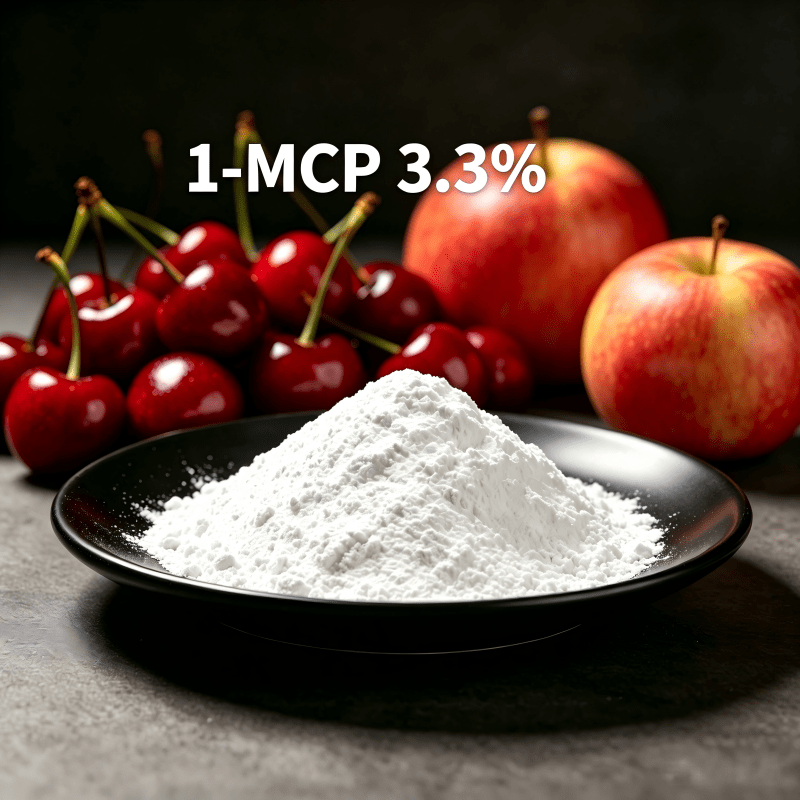
Product Mechanism Overview
1-MCP belongs to the class of plant growth regulators known as ethylene action inhibitors. Once bound to ethylene receptors, it “locks” them, preventing both internal and external ethylene from triggering the fruit ripening signal cascade. It is extensively used for extending the shelf life of fruits, vegetables, and cut flowers.
General Application Method
This product is a water-soluble wettable powder that releases 1-MCP gas upon contact with water. Treatment must be conducted in a sealed environment (cold room, shipping container, storage facility, etc.) via fumigation.
Standard Treatment Procedure:
Calculate the required dosage based on the treatment volume and crop type (see dosage tables below).
Place the measured powder into a wide-mouth container.
Add the specified amount of clean water to initiate gas release.
Immediately seal the storage facility and maintain an airtight seal for 12–24 hours.
After treatment, ventilate the area thoroughly before handling the produce.
Key Considerations:
Treatment should be applied as soon as possible after harvest, ideally within 24 hours, for maximum efficacy.
Excessively low treatment temperatures (e.g., below 10°C) may reduce effectiveness; the recommended storage temperature for the specific crop is generally suitable.
Always conduct a small-scale trial before large-scale commercial application.
After treatment, fruit can be stored at a temperature 1°C higher than that of untreated fruit, with a relative humidity effectively maintained at 90%–95%.
Detailed Application Guide for Fruits
Apple
Apple is a typical climacteric fruit. Postharvest ethylene production accelerates ripening and senescence. Studies show that a 1 µL·L⁻¹ 1-MCP treatment effectively reduces respiration rate and decay, significantly improves fruit firmness and soluble solids content, and can increase firmness by 4.76%–9.03%.
For small-package preservation, one sachet of 1-MCP microcapsule granules can be placed in each carton of apples (10–15 kg) and stored at room temperature. An effective concentration of 2–4 g/m³ is recommended.
| Parameter | Recommended Value |
|---|---|
| Recommended Concentration | 1 µL·L⁻¹ (approx. 0.5–1 g per 15 m³) |
| Treatment Time | 12–24 hours |
| Treatment Temperature | Room temperature or cold storage temperature |
| Application Timing | Within 24 hours after harvest |
| Storage Conditions | Can be stored at 1°C higher than untreated fruit |
| Shelf Life Extension | 2–3 times longer |
Pear
Pears are also climacteric and prone to physiological disorders such as superficial scald during long-term cold storage, with losses exceeding 40% in some susceptible varieties. 1-MCP acts as a metabolic regulator, reprogramming the fruit’s metabolic network to suppress browning-related compounds. According to Chinese pesticide registration data, the recommended dosage for pears is 30–62.5 g/m³ of the formulated product.
| Parameter | Recommended Value |
|---|---|
| Recommended Dosage | 30–62.5 g/m³ (formulated product) |
| Treatment Time | 12–24 hours |
| Treatment Temperature | Room temperature or cold storage temperature |
| Application Timing | As soon as possible after harvest |
| Suitable Varieties | Dangshan pear, Yali pear, Xuehua pear, etc. |
Banana
1-MCP effectively delays color change during banana ripening. Dipping in a 25–50 μg·L⁻¹ 1-MCP solution at 20°C can delay ripening by up to 12 days at 20°C. The respiration peak is significantly postponed, from 39–44 days in the control to 51–59 days in treated fruit.
| Parameter | Recommended Value |
|---|---|
| Recommended Concentration | 25–50 μg·L⁻¹ (active ingredient) |
| Treatment Time | 12–24 hours |
| Treatment Temperature | 20°C |
| Application Timing | Mature green stage |
| Shelf Life Extension | 10–12 days at 20°C |
Mango
1-MCP significantly reduces ethylene production and inhibits the activity of softening-related enzymes (PE, EGase, exo-PG, endo-PG) in both peel and pulp, delaying softening and ripening. For more ripened mangoes (yellow stage), sensitivity to 1-MCP decreases markedly; treatment should be applied before full yellowing. A recommended dose is 1 set per container (approx. 70–80 m³) with fumigation for at least 24 hours.
| Parameter | Recommended Value |
|---|---|
| Recommended Dosage | 1 set per 70–80 m³ |
| Treatment Time | 24 hours (minimum) |
| Treatment Temperature | Room temperature |
| Application Timing | Mature green to initial color change |
| Shelf Life Extension | 1–2 weeks |
Plum
Plums are climacteric, and rapid postharvest softening limits their storage and transport. 1-MCP treatment delays and suppresses the respiration climacteric peak and reduces softening enzyme activity. The recommended dosage for plums is 30–92.5 g/m³ of the formulated product.
| Parameter | Recommended Value |
|---|---|
| Recommended Dosage | 30–92.5 g/m³ (formulated product) |
| Treatment Time | 12–24 hours |
| Treatment Temperature | Room temperature or cold storage temperature |
| Application Timing | As soon as possible after harvest |
Citrus
Citrus is a non-climacteric fruit, but postharvest dehydration, decay, and rind aging still occur. Studies indicate that a concentration of 50–500 µL·L⁻¹ 1-MCP can reduce chilling injury and rind spots. However, concentrations exceeding 1 mg·L⁻¹ may promote decay.
| Parameter | Recommended Value |
|---|---|
| Recommended Concentration | 50–500 µL·L⁻¹ |
| Treatment Time | 12–24 hours |
| Treatment Temperature | Cold storage temperature |
| ⚠️ Caution | Do not exceed 1 mg·L⁻¹ to avoid promoting decay |
Tomato
Tomato is a model climacteric fruit. 1-MCP tightly binds to ethylene receptors, blocking signal transduction and delaying the respiration peak. The recommended dosage for tomatoes is 62.5–92 g/m³ of the formulated product.
| Parameter | Recommended Value |
|---|---|
| Recommended Dosage | 62.5–92 g/m³ (formulated product) |
| Treatment Time | 12–24 hours |
| Treatment Temperature | Room temperature or cold storage temperature |
| Application Timing | Mature green to breaker stage |
Grape
1-MCP is effective for grape preservation. The reference dosage for grapes is 30–62.5 g/m³ of the formulated product.
| Parameter | Recommended Value |
|---|---|
| Recommended Dosage | 30–62.5 g/m³ (formulated product) |
| Treatment Time | 12–24 hours |
| Treatment Temperature | Cold storage temperature |
| Application Timing | As soon as possible after harvest |
Hami Melon (Cantaloupe)
For postharvest preservation of Hami melons, local standards exist that recommend full-truck (warehouse) fumigation technology with strict operational procedures.
| Parameter | Recommended Value |
|---|---|
| Recommended Dosage | Follow local standard DB6521_T 072-2024 |
| Treatment Time | 12–24 hours |
| Treatment Temperature | Cold storage temperature |
| Application Timing | After precooling |
Kiwifruit, Avocado, and Pineapple
1-MCP is equally effective for tropical and subtropical fruits such as kiwifruit, avocado, and pineapple. Treated fruit shows delayed softening and better maintenance of sensory and physiological quality. For most of these crops, use 1 set per 70–80 m³ with a fumigation duration of at least 24 hours.
| Parameter | Recommended Value |
|---|---|
| Recommended Dosage | 1 set per 70–80 m³ |
| Treatment Time | 24 hours (minimum) |
| Treatment Temperature | Room temperature or cold storage temperature |
| Application Timing | As soon as possible after harvest |
Detailed Application Guide for Vegetables
Broccoli
Postharvest yellowing is the main factor limiting broccoli shelf life and is mediated by ethylene. Research confirms that a 1 µL·L⁻¹ 1-MCP treatment for 12 hours significantly inhibits ethylene-induced respiration and yellowing at 10°C. The recommended dosage for cauliflower/broccoli is 15.6–31.3 g/m³ of the formulated product.
| Parameter | Recommended Value |
|---|---|
| Recommended Dosage | 15.6–31.3 g/m³ (formulated product) |
| Treatment Time | 12 hours |
| Treatment Temperature | 10°C |
| Application Timing | As soon as possible after harvest |
| Suitable Types | Cauliflower, broccoli (calabrese) |
Cucumber
Cucumbers are chilling-sensitive vegetables prone to postharvest wilting and yellowing. 1-MCP reduces respiration rate and delays chlorophyll degradation and tissue senescence.
| Parameter | Recommended Value |
|---|---|
| Recommended Dosage | 0.5–1 g per 15 m³ (cold room) |
| Treatment Time | 12–18 hours |
| Treatment Temperature | 10–12°C |
| Application Timing | Within 6–12 hours after harvest |
Pepper
Postharvest peppers are susceptible to water loss, shriveling, and color deterioration. 1-MCP reduces respiration and ethylene production, effectively delaying color change to red and softening.
| Parameter | Recommended Value |
|---|---|
| Recommended Dosage | 0.5–1 g per 15 m³ (cold room) |
| Treatment Time | 12–24 hours |
| Treatment Temperature | 10–12°C |
| Application Timing | Within 12 hours after harvest |
Detailed Application Guide for Ornamentals
Carnation
Carnations are highly ethylene-sensitive cut flowers; exposure to very low ethylene levels causes petal inrolling and wilting. The recommended dosage for carnations is 60–100 g/m³ of the formulated product using sealed fumigation.
| Parameter | Recommended Value |
|---|---|
| Recommended Dosage | 60–100 g/m³ (formulated product) |
| Application Method | Sealed fumigation |
| Treatment Time | 12–24 hours |
| Treatment Temperature | Room temperature |
| Application Timing | Immediately after harvest |
Rose
Roses are among the most important cut flowers globally and are highly ethylene-sensitive. A preharvest spray of 10 µL·L⁻¹ 1-MCP at the red-bud stage extends vase life by about 2.5 days compared to controls. Postharvest fumigation at 0.4 µL·L⁻¹ for 4 hours is also highly effective.
| Parameter | Recommended Value |
|---|---|
| Recommended Concentration | 0.4–10 µL·L⁻¹ |
| Treatment Time | 4–12 hours |
| Treatment Temperature | Room temperature |
| Application Timing | Immediately after harvest |
| Vase Life Extension | Approximately 2.5 days |
Lily
Studies confirm that 150 nL/L 1-MCP is most effective for inhibiting respiration, extending vase life, and delaying senescence in cut lilies. An optimal integrated preservative formula is 150 nL/L 1-MCP + 40 mg/L 6-BA + 40 mg/L GA₃ + 30 g/L sucrose, supplemented with 150 mg/L citric acid and 200 mg/L 8-HQ.
| Parameter | Recommended Value |
|---|---|
| Recommended Concentration | 150 nL/L (approx. 0.15 µL·L⁻¹) |
| Integrated Formula | 150 nL/L 1-MCP + 40 mg/L 6-BA + 40 mg/L GA₃ + 30 g/L sucrose |
| Supplementary Agents | Citric acid 150 mg/L + 8-HQ 200 mg/L |
| Treatment Time | 12–24 hours |
| Treatment Temperature | Room temperature |
Chrysanthemum
Chrysanthemums are ethylene-sensitive. A 2 µL/L 1-MCP treatment extends vase life by approximately 7.75 days, significantly improving water uptake and water balance while delaying senescence.
| Parameter | Recommended Value |
|---|---|
| Recommended Concentration | 2 µL/L |
| Treatment Time | 12–24 hours |
| Treatment Temperature | Room temperature |
| Application Timing | As soon as possible after harvest |
| Vase Life Extension | Approximately 7.75 days |
Gerbera
Gerberas are ethylene-sensitive and highly prone to postharvest stem bending (“drooping”). 1-MCP effectively inhibits ethylene synthesis and its action, delaying ethylene-induced senescence.
| Parameter | Recommended Value |
|---|---|
| Recommended Concentration | 0.5–1 µL·L⁻¹ |
| Treatment Time | 6–12 hours |
| Treatment Temperature | Room temperature |
| Application Timing | Immediately after harvest |
Other Ornamentals & Cut Flowers
1-MCP is effective for a wide range of cut flowers and potted ornamentals, protecting quality against the detrimental effects of ethylene.
| Type | Representative Species |
|---|---|
| Other Cut Flowers | Tulip, stock, baby’s breath, forget-me-not |
| Potted Plants | Potted rose, potted chrysanthemum, poinsettia |
| Cut Foliage | Ferns, eucalyptus |
General Recommended Dosage: 0.4–1 µL·L⁻¹ for 4–12 hours.
Compatibility, Safety & Storage
Compatibility
1-MCP 3.3% WP can generally be integrated with non-alkaline fungicides and preservative treatments, but sequence matters. It is recommended to apply 1-MCP fumigation first, ventilate thoroughly, and then apply other treatments such as coatings or fungicide sprays.
Safety & Handling
This product is a low-toxicity plant growth regulator. However, wear gloves and a dust mask when handling, and avoid inhaling dust.
The product has a 2-year shelf life. Store in a cool, dry, well-ventilated area, away from heat, fire sources, and out of reach of children.
Dispose of packaging waste properly according to local regulations. Do not clean application equipment near water bodies.
Pregnant and breastfeeding women should avoid contact with this product.
Important Notes
Ethylene Exposure Sensitivity: If fruit has been exposed to ethylene for more than 24 hours before treatment, the efficacy of 1-MCP can drop significantly (by up to 60%).
Concentration Accuracy: Under-dosing yields poor results; over-dosing can cause phytotoxicity (e.g., decay in citrus). Strictly adhere to recommended concentrations.
New Crop Application: Always conduct a small-batch trial in the treatment space before scaling up to untested crops.
Synergy with Controlled Atmosphere (CA) Storage: 1-MCP treatment followed by CA storage produces a synergistic effect, outperforming either method alone.
Precooling: Cool fruit to the appropriate storage temperature as quickly as possible after harvest before applying 1-MCP. High temperatures during treatment may reduce effectiveness.
Frequently Asked Questions (FAQ)
What is 1-MCP and how does it work?
1-Methylcyclopropene (1-MCP) is a potent ethylene action inhibitor. It binds to ethylene receptors in plant tissues with approximately 10 times greater affinity than ethylene itself, effectively blocking the ripening signal and delaying senescence.
What crops can be treated with 1-MCP 3.3% WP?
1-MCP is effective on a wide range of ethylene-sensitive crops, including apples, pears, bananas, mangoes, kiwis, avocados, tomatoes, broccoli, cucumbers, and various cut flowers such as carnations, roses, lilies, and chrysanthemums.
What is the recommended dosage for apples?
For apples, the recommended concentration is 1 µL·L⁻¹ (approximately 0.5–1 g per 15 m³ of storage space), with a treatment duration of 12–24 hours, applied within 24 hours after harvest.
How should bananas be treated with 1-MCP?
Mature green bananas should be treated with 25–50 μg·L⁻¹ 1-MCP (active ingredient) at 20°C for 12–24 hours in a sealed environment. This can delay ripening by up to 10–12 days at 20°C.
Can 1-MCP be used on cut flowers?
Yes. 1-MCP is highly effective for cut flower preservation. For example, chrysanthemums treated with 2 µL/L 1-MCP showed a vase life extension of approximately 7.75 days, while carnations require 60–100 g/m³ in sealed fumigation.
Is 1-MCP safe for use on food crops?
Yes. 1-MCP has been exempted from residue tolerance requirements by the U.S. EPA, and is classified as a low-toxicity plant growth regulator. No detectable residues remain when used as directed.
How should 1-MCP 3.3% WP be stored?
Store in a cool, dry, and well-ventilated place away from heat sources and direct sunlight. Keep the container tightly sealed and out of reach of children. The shelf life is approximately 2 years under proper storage conditions.
Can 1-MCP be combined with other postharvest treatments?
Yes, 1-MCP can be integrated into standard postharvest handling protocols. It often shows synergistic effects when combined with controlled atmosphere (CA) storage. However, it is recommended to apply 1-MCP fumigation first, ventilate, then apply other treatments such as fungicide sprays or coatings.
References
Lin, H., et al. (2024). Practical 1-Methylcyclopropene Technology for Increasing Apple (Malus domestica Borkh) Storability in the Aksu Region. Foods, 13(18), 2918.
Satekge, T. K., & Magwaza, L. S. (2022). Delaying ripening using 1-MCP reveals chilling injury symptom development at the putative chilling threshold temperature for mature green banana. Frontiers in Plant Science, 13, 966789.
Satekge, T. K., & Magwaza, L. S. (2022). Responses of 1-methylcyclopropene (1-MCP)−treated banana fruit to pre− and post−treatment ethylene exposure. Scientia Horticulturae, 309, 111636.
Wang, L., Mi, Y. F., & Chang, Q. S. (2026). Effects of 1-MCP, Nano-silver, and Combined Solution on the Vase Performance of Chrysanthemum ‘Guohua Wanwu’.
Effect of 1-MCP Treatment on the Preservation of Apples Stored in Cartons. (2013).
Zhu, D. X., Shen, Z. G., & Meng, J. (n.d.). Preservative Effects of 1-MCP Treatment and Integrated Formula on Cut Lily Flowers. Journal of Northwest A&F University (Natural Science Edition).
ChemicalBook. 1-Methylcyclopropene Pesticide Registration Database.
Postharvest Action Group (PAG). (2025). Recommended Temperature Protocols for Standard and Cold Sterilisation Markets for Pome Fruit.